
Ontario · ON
Heat pumps in Ontario (2026): costs, rebates and running costs
What a heat pump costs installed and after Home Renovation Savings, what the federal rebate and the free program add, and what it costs to run against Enbridge gas, baseboard or oil.
- A guide, not an installer
- Prices and rebates sourced and dated
- Federal and provincial rebates tracked
- Cold-climate (CCHP) performance data
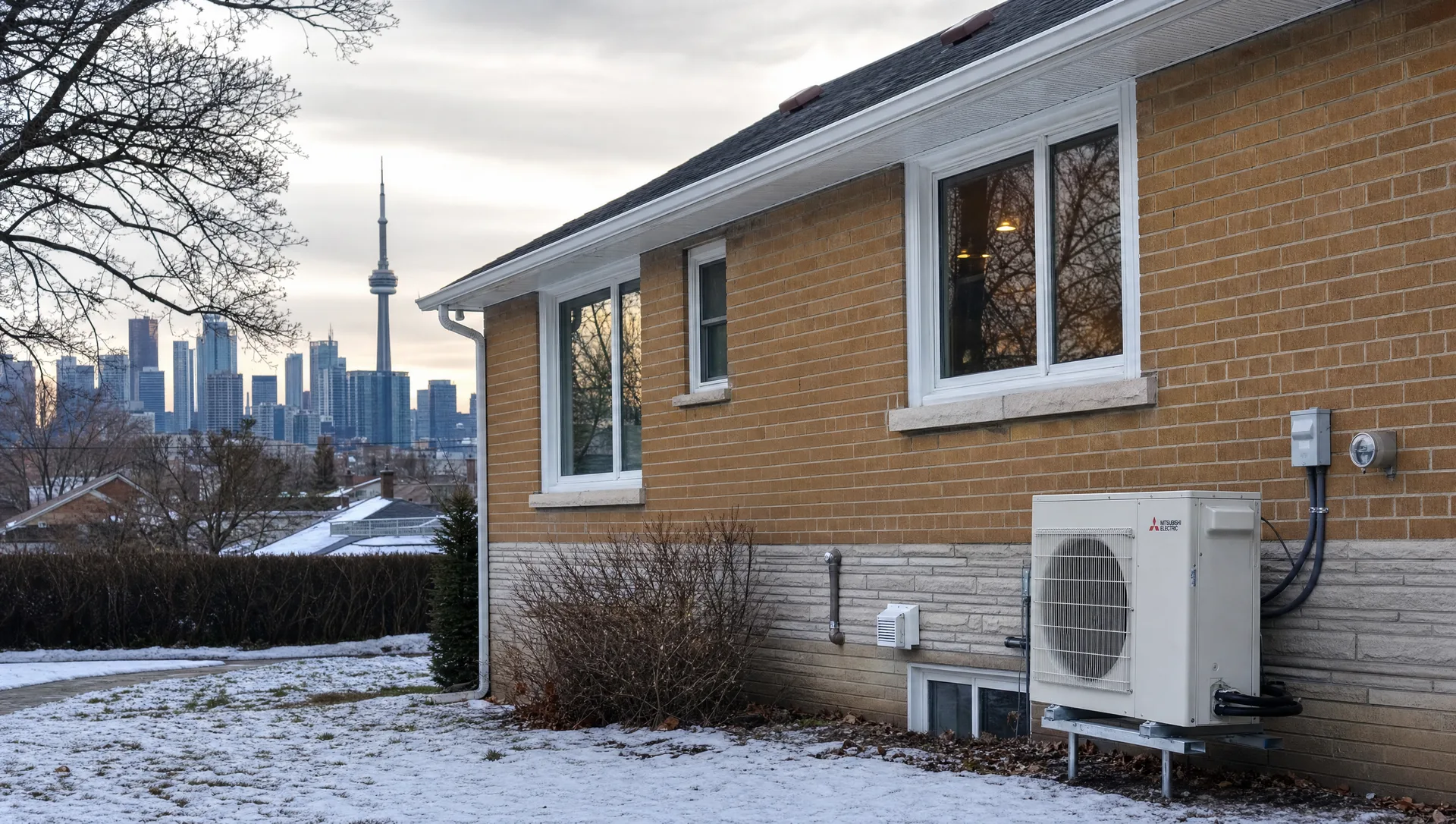
Ontario at a glance
How much does a heat pump cost in Ontario after rebates?
In Ontario, a ducted cold-climate heat pump costs $12,000–$19,000 installed in a typical 2,000 to 2,500 sq ft home. In a home heated by electricity, oil, propane or wood, Home Renovation Savings pays $1,250 per ton, up to $7,500, which leaves $8,250–$15,250 for a ducted system. In an Enbridge gas home it pays $500 per ton, up to $2,000, and a heat pump that keeps the furnace as backup comes to $4,500–$8,500 after the rebate.
The federal National Heat Pump Rebate adds $2,000, or up to $10,000 at or below an income limit that is $146,217 after tax for a household of four in Ontario. It covers installs from November 1, 2026 and opens in early 2027. Income-eligible homes heated by electricity or oil can get a heat pump free through the Energy Affordability Program.
What does a heat pump cost to run in Ontario?
Less than electric baseboard or oil, and more than an Enbridge gas furnace. At Ontario prices from November 1, 2026, 1,000 kWh of heat costs about:
- $31 from an Enbridge gas furnace
- $48–$66 from a cold-climate heat pump
- $140–$159 from electric baseboard heaters
- $277–$288 from an oil furnace
The electricity and gas figures include delivery and tax but not the fixed monthly charges. The heat pump range runs from a high-efficiency unit on time-of-use prices to an entry-level cold-climate unit on tiered prices. The Ontario running-cost comparison works this through for a whole year.
Ontario heat pump guides
- Heat pump cost in Ontario: installed prices by home size, after rebates, and to run
- Ontario heat pump rebates: every program compared, who is eligible and how to apply
- Home Renovation Savings: what the Enbridge and Save on Energy program pays, including insulation and thermostats
- Free heat pumps in Ontario: the Energy Affordability Program's income limits and how to apply
- National Heat Pump Rebate: the federal income limits, eligibility and receipt rules
- Heat pump vs furnace in Ontario: a year of heat from Enbridge gas, a heat pump, baseboards and oil
- Why is my hydro bill so high with a heat pump?: backup heat, defrost, setbacks and price plans
City guides for Toronto, Ottawa, Hamilton and 24 other Ontario cities are further down.
Ontario installation pricing
What you'll pay in Ontario
Ducted air-source
$12,000–$19,000
Tied into existing forced-air ductwork. Cold-climate-rated (CCHP) units rated to -30°C.
Ductless mini-split
$4,000–$8,500
Single-zone or multi-zone, wall-mounted indoor units. Ideal for homes without ducts.
Grants and rebates
up to $8,000
Largest combined total for one system, for a household at market income.
See how these figures are built, or price your own home, in the heat pump cost guide for Ontario.
Ontario heat pump rebates: what each program pays and how to apply
Climate fit
Why heat pumps make sense in Ontario
Ontario's climate is classified as continental — cold winters and hot summers mean inverter-driven cold-climate heat pumps (CCHPs) are essential. Most homes here use natural gas, so heat pump installation typically pairs with a gas backup (dual-fuel) for sub-zero days.
- A guide, not an installer
- Prices and rebates sourced and dated
- Federal and provincial rebates tracked
- Cold-climate (CCHP) performance data
Recommended equipment for ON
What kind of heat pump fits Ontario's climate
What to look for
Cold-climate heat pumps (CCHP) with backup capacity for the coldest weeks. Most homes here run dual-fuel with the existing natural-gas furnace as backup below -15°C.
Minimum specifications
Minimum HSPF 10, SEER 16. Provincial rebates generally require a unit on a qualified-product list, so check the exact model before signing. Heat pump must maintain at least 70% rated capacity at -15°C.
What to avoid
Single-stage compressors. Inverter (variable-capacity) is the only sensible choice in continental climates — modulating from 30% to 100% output matches typical Canadian load patterns.
Conversion path
How Ontario homes typically convert to heat pumps
Most installations here keep the existing gas furnace as backup. A dual-fuel thermostat switches to gas below your "balance point" (typically -8°C to -15°C depending on heat pump sizing). You get electric heat-pump efficiency 80-90% of heating hours and gas only when the heat pump becomes uneconomical.
Gas-heavy provinces like Ontario have a more nuanced economics case. Natural gas is the cheapest fossil heating fuel in Canada by operating cost, so the savings come from offsetting cooling load (replacing AC) and from running the heat pump through the mild shoulder seasons. Dual-fuel installations keep the gas furnace as backup for the coldest days, and gas-heated homes qualify for smaller provincial rebates where any exist.
Timeline
How long the process takes in Ontario
Quotes typically come back within a day or two, and installation itself takes 1-3 days once scheduled. Where a provincial rebate requires an energy assessment before the work, book it before anything is installed.
None of it should happen in the dark. A good installer confirms each milestone as it passes — rebate paperwork submitted, audit booked, audit complete, loan approved, install scheduled, install complete, post-retrofit audit complete, final disbursement received. Silence between milestones is the most common early warning sign on a retrofit that is going wrong.
City guides
Heat pump installation guides for Ontario cities
Hamilton and nearby towns
These guides add each town’s electricity and gas suppliers, its building-code design temperature, its 2021 census housing mix, the local permit and zoning rules for the outdoor unit, and any city program, with every fact linked to the official page it came from.
- Hamilton: with Stoney Creek, Alectra or Hydro One, and the City’s zoning rule
- Ancaster: newer homes, and a hydro company that depends on your address
- Dundas: older homes and the new Melville-Park West heritage district
- Waterdown: where Alectra stops, and the Mill Street heritage district
- Burlington: Burlington Hydro, and which swaps need no permit
- Oakville: Oakville Hydro, and the air conditioner noise limit
- Brantford: GrandBridge Energy, and a front-yard rule for outdoor HVAC
- Grimsby: Grimsby Power, and the Escarpment exception
- Beamsville: Lincoln’s zoning names heat pumps: within 3 m of the house
- Mississauga: Alectra, the HVAC permit, and condos
- St. Catharines: Alectra, the HVAC permit and the zoning rule
- Toronto, ON
- Ottawa, ON
- Mississauga, ON
- Brampton, ON
- Hamilton, ON
- London, ON
- Markham, ON
- Vaughan, ON
- Kitchener, ON
- Windsor, ON
- Burlington, ON
- Oakville, ON
- Barrie, ON
- Guelph, ON
- Kingston, ON
- Whitby, ON
- Oshawa, ON
- Ajax, ON
- Cambridge, ON
- Waterloo, ON
- St. Catharines, ON
- Ancaster, ON
- Dundas, ON
- Waterdown, ON
- Brantford, ON
- Grimsby, ON
- Beamsville, ON
Find a qualified installer
This site is a guide. It does not sell or install heat pumps. The programs and directories below are where to find registered contractors and the rebate rules that apply in each province.
- National Heat Pump Rebate (Government of Canada)
The new federal rebate announced in October 2026: up to $10,000 below the median income and $2,000 for others, opening in early 2027. The official page has a sign-up for launch updates.
- Canada Greener Homes Affordability Program (NRCan)
No-cost heat pump and insulation retrofits for low- and median-income homeowners and tenants, applied for through the provincial partner. The federal Greener Homes Loan and Oil to Heat Pump Affordability program are closed.
- HRAI contractor directory
The Heating, Refrigeration and Air Conditioning Institute of Canada lists member HVAC contractors by region.
- Home Renovation Savings — Ontario
Ontario's rebate for cold-climate and ground-source heat pumps, paid per ton, and its qualified-product rules.
- Home Renovation Rebate — British Columbia
The BC Hydro and CleanBC rebate for heat pumps that replace electric heat, and the program rules that go with it.
- Efficiency Manitoba
Manitoba rebates for ducted and ductless cold-climate heat pumps.
- Efficiency Nova Scotia
Nova Scotia rebate programs and the approved-installer requirements that go with them.
Common questions
How much does a heat pump cost to install in Ontario?
Ducted air-source heat pumps in Ontario typically cost $12,000–$19,000 installed. Single-zone ductless systems run $4,000–$8,500. Home size, electrical service and existing ductwork move the number; the heat pump cost calculator adjusts for all three.
What rebates are available for heat pumps in Ontario?
Ontario homeowners can draw on up to $8,000 in grants and rebates. Programs that can apply in Ontario: Home Renovation Savings — cold-climate air-source heat pump ($1,250 per ton, up to $7,500), Home Renovation Savings — cold-climate air-source heat pump (gas-heated home) ($500 per ton, up to $2,000), Home Renovation Savings — ground-source heat pump ($2,000 per ton, up to $12,000), Home Renovation Savings — ground-source heat pump (gas-heated home) (up to $3,000). Separately, the federal National Heat Pump Rebate will add up to $10,000 for households below the median income, or $2,000 for others. It opens in early 2027 and covers eligible installs from November 1, 2026. The provincial rebate stacking guide explains how they combine.
Do heat pumps work in Ontario's climate?
Yes. Ontario's climate (continental) means cold winters and hot summers mean inverter-driven cold-climate heat pumps (CCHPs) are essential. Modern cold-climate heat pumps (CCHPs) are rated to operate at -30°C and below — well within Canadian-winter parameters.
How long does installation take in Ontario?
Most ducted retrofits in Ontario take 1-2 days. Ductless single-zone installations are typically 1 day. Multi-zone systems with 3+ indoor heads take 2-3 days. Geothermal is a larger project (5-10 days). Rebate paperwork adds 2-4 weeks for approvals but does not delay installation.