
The Canadian-winter authority guide
Cold-climate heat pumps work — here's why
The technology that struggled in the 2010s has been replaced. Modern cold-climate heat pumps (CCHPs) deliver useful heat down to -30°C and below, run at COP 2-3 in deep winter, and have completely changed the Canadian heating economics conversation.
- Free quotes within 24 hours
- Licensed + insured installers
- Cold-climate-rated (CCHP) systems
- Greener Homes Loan paperwork handled
What changed: variable-speed inverters
The breakthrough that made cold-climate heat pumps viable in Canada was the variable-speed inverter compressor. Older heat pumps (pre-2015) used single-stage compressors — they ran at one speed, period. When outdoor temperatures dropped, the unit couldn\'t scale up its output, and homeowners ran out of heat below -10°C.
Modern cold-climate models use inverter-driven compressors that modulate output across a 20-100% range. When it\'s -25°C outside, the compressor ramps up to 100% capacity and runs longer cycles. When it\'s +5°C, it throttles down to 25% and runs quietly in the background. This is why a properly sized CCHP maintains comfort at temperatures that destroyed first-generation systems.
The specs that matter
HSPF (Heating Seasonal Performance Factor)
HSPF measures how much heat the unit produces per unit of electricity over an entire heating season — a higher number is better. For Canadian winter performance, the threshold is HSPF 10 or higher. Anything below 9 will struggle in cold climates. Top Canadian-market models reach HSPF 12-14.
Rated minimum operating temperature
This is the absolute floor temperature where the manufacturer guarantees the unit will continue producing useful heat. Look for -25°C or -30°C minimums for most Canadian regions. Northern Canada (Yukon, NWT, Nunavut) needs -35°C or colder ratings, which only a few specialty units provide.
ENERGY STAR cold-climate certification
A specific certification separate from the standard ENERGY STAR mark. The cold-climate certification requires the unit to maintain 70%+ of rated heating capacity at -15°C — proving it doesn\'t fall off a cliff in deep winter. Check the ENERGY STAR Canada database before signing any quote.
Cold-climate models with proven Canadian-winter performance
Brands shipping certified cold-climate equipment in Canada. Capacity retention is the spec that matters most — it tells you how much rated heating output the unit actually delivers at deep-winter temperatures. Verify any specific model against the ENERGY STAR Canada certified product database before signing a quote.
| Brand / model line | Form factor | Rated to | HSPF | Best-fit Canadian use |
|---|---|---|---|---|
| Mitsubishi Hyper-Heating (H2i) | Ductless / ducted | −25°C | 11–13 | Maritime + Atlantic gold standard; strong field record |
| Carrier Greenspeed / Bryant Evolution | Ducted central | −25°C | 13+ | Leading ducted retrofit option; whole-home loads |
| Daikin Aurora / Atmosphera | Ductless / ducted | −25°C | 10–12 | Long Canadian track record across all provinces |
| Fujitsu XLTH | Ductless specialist | −25°C | 12–13 | Maritime + Atlantic ductless retrofits |
| Lennox XP25 | Ducted variable-speed | −18°C | 11+ | High-end Ontario + Prairie dual-fuel pairs |
| Trane XV20i | Ducted variable-speed | −18°C | 10–11 | Established Canadian dealer network |
Specific model recommendations should come from your installer based on your home's heating load. Don't fixate on brand — fixate on the spec sheet (specifically: capacity at your provincial design temperature, and ENERGY STAR cold-climate certification).
Sizing: the single biggest decision
A heat pump that\'s too small can\'t keep up in deep winter. A heat pump that\'s too big short-cycles, doesn\'t dehumidify well in summer, and wears out faster.
Proper sizing in Canada requires a Manual J load calculation — a room-by-room analysis of your home\'s heat loss at the local design temperature (typically -20°C to -30°C depending on region). A good installer spends 30-60 minutes on this assessment during the quote visit. If a contractor pulls a number out of their head ("you need a 3-ton unit"), get a second quote.
Defrost cycles — what to expect
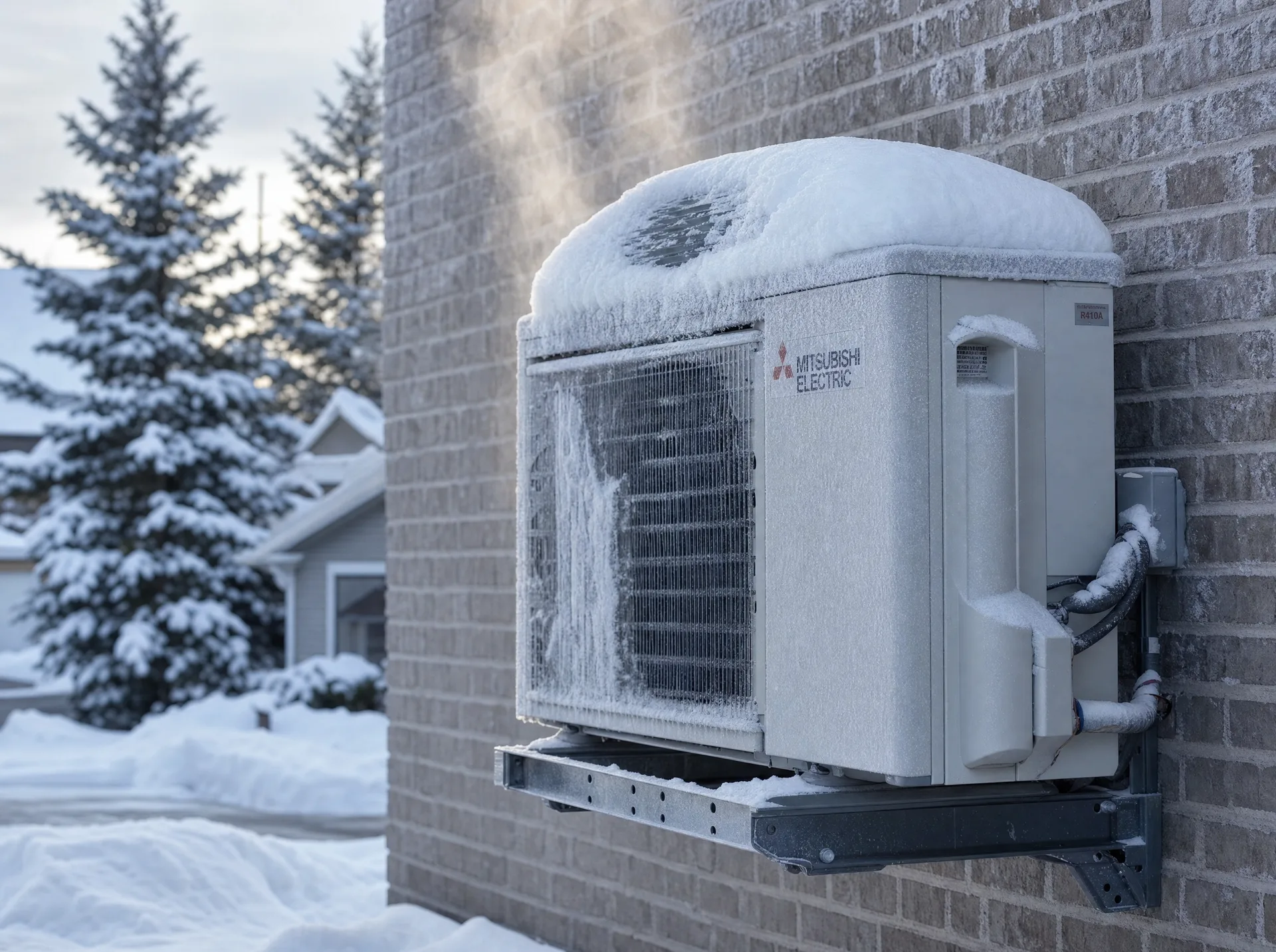
The outdoor coil collects frost when extracting heat from sub-freezing air. Every 30-90 minutes during cold weather, the system runs a defrost cycle — it reverses to cooling mode briefly to melt the frost off the coil. You\'ll see steam coming off the unit and the indoor fan stops blowing warm air for 5-10 minutes.
This is normal and automatic. The only thing you can control is installation height: the outdoor unit should be on a wall-mounted bracket or elevated stand 18-30 inches off the ground so accumulated snow doesn't block airflow. Don't install the unit on a concrete pad sitting at grade level in regions with deep snow.
Sources
Last full source check: 2026-05-23.
Find a qualified installer
This site is an independent guide. It does not sell or install heat pumps and does not provide quotes. The programs and directories below are where to find registered contractors and the rebate rules that apply in each province.
- Canada Greener Homes Loan (NRCan)
The federal interest-free loan. The official page lists eligibility, the registered energy-advisor requirement, and how to apply.
- Oil to Heat Pump Affordability Program (NRCan)
Federal support for households switching from oil heat, with the current eligibility rules and application steps.
- HRAI contractor directory
The Heating, Refrigeration and Air Conditioning Institute of Canada lists member HVAC contractors by region.
- Save on Energy — Ontario
The Ontario heat pump incentive program and its list of participating contractors.
- CleanBC Better Homes — British Columbia
Provincial rebates for BC, including the program registered-contractor search.
- Efficiency Nova Scotia
Nova Scotia rebate programs and the approved-installer requirements that go with them.
Common questions
Do heat pumps work in Canada?
Yes. Modern cold-climate heat pumps (CCHPs) certified by ENERGY STAR Canada are explicitly engineered for Canadian winters. The mainstream CCHP models from Mitsubishi (Hyper-Heating), Fujitsu (XLTH), Daikin (Aurora), Carrier (Greenspeed), and Lennox (XP25) all maintain useful heat output down to -25°C or -30°C. The "heat pumps don't work in cold weather" view is mostly based on 10+ year old equipment that genuinely struggled below -10°C — modern inverter-driven cold-climate models are fundamentally different technology and work in every Canadian province.
What is a cold climate heat pump?
A cold climate heat pump (CCHP) is a heat pump engineered for sub-zero operation using three technologies that ordinary heat pumps lack: a variable-speed inverter compressor that modulates output continuously, enhanced vapor injection (EVI) in the refrigerant cycle for boosted low-temperature capacity, and cold-climate refrigerant blends (R-454B, R-32) that maintain proper pressures down to -30°C. The ENERGY STAR Canada Cold Climate Heat Pump certification verifies these features and is the certification you should look for on the equipment data sheet.
Do heat pumps work in -20°C?
Yes, with strong performance. A representative ENERGY STAR Cold Climate certified heat pump delivers approximately 63% of its rated heating capacity at -20°C, with a COP of around 2.0 — meaning each kWh of electricity still moves 2 kWh of heat. This is double the efficiency of electric resistance heating. Real-world field reports from Canadian homeowners (Reddit, utility-program monitoring data from BC Hydro and Efficiency Nova Scotia) consistently confirm CCHPs maintain interior comfort through -20°C and -25°C weather when correctly sized.
How do I know if a heat pump is cold-climate certified?
Look for two signals on the data sheet: (1) ENERGY STAR Canada Cold Climate Heat Pump certification (a specific certification, not the standard ENERGY STAR mark), and (2) HSPF rating of 10 or higher (Region IV, which is the cold-climate test profile — not Region I which is mild-US). Both must be present. Equipment with only the standard ENERGY STAR mark is fine for milder coastal climates but will lose substantial capacity below -15°C and is not eligible for the federal Greener Homes Loan in most provinces.
Do I need a backup heat source?
Depends on climate and equipment. In coastal BC, southern Ontario, and the Maritimes, a properly sized cold-climate heat pump can run as a 100% standalone system year-round. In the Prairies (Alberta, Saskatchewan, Manitoba) and northern Canada, backup is recommended for the coldest 1-5% of winter hours — either an existing natural-gas furnace kept as auxiliary (dual-fuel) or electric resistance backup integrated into the air handler. The decision depends on your provincial design temperature and the heat pump's capacity at that temperature. Your installer's Manual J calculation determines this.
What about ice buildup on the outdoor unit?
A normal part of operation. The outdoor coil collects frost when extracting heat from sub-freezing humid air. The system runs periodic defrost cycles — typically every 30-90 minutes in -2°C to +5°C humid weather, less frequently below -10°C, and rarely above +7°C. Each cycle lasts 5-10 minutes. You may see steam rising from the unit during defrost as melt water evaporates — that's expected. As long as the unit is installed on an elevated bracket or stand (not sitting in snow) and has proper airflow clearance, defrost handles everything automatically.
Will my electricity bill spike in winter?
Cold-climate heat pumps still operate at a COP of 2-3 even at -25°C — meaning you get 2-3 units of heat for every unit of electricity. That's significantly more efficient than electric resistance heating (COP 1.0) and competitive with natural gas at most Canadian electricity rates. Your monthly bill in January will be higher than your bill in May (heating loads are larger), but your annual heating cost should drop 30-60% compared to oil or electric resistance heating, and remain roughly comparable to natural gas. Watch for the rare case where a home with electric baseboards converts to a heat pump that's slightly under-sized — that scenario can see January spikes from resistance-backup running unexpectedly.