
Toronto · ON
Heat pump installation in Toronto
What a retrofit costs in Toronto and the surrounding Ontario communities, up to $8,000 in grants and rebates, and how the local housing stock changes the equipment answer.
- A guide, not an installer
- Prices and rebates sourced and dated
- Federal and provincial rebates tracked
- Cold-climate (CCHP) performance data
Ducted installs in Toronto
$12,000–$19,000
Ductless installs in Toronto
$4,000–$8,500
Grants and rebates
up to $8,000
These are Ontario-wide ranges. Estimate a home in Toronto with the cost calculator.
- A guide, not an installer
- Prices and rebates sourced and dated
- Federal and provincial rebates tracked
- Cold-climate (CCHP) performance data
What does a heat pump cost in Toronto after rebates?
In Toronto, as across Ontario, a ducted cold-climate heat pump costs $12,000–$19,000 installed in a typical 2,000 to 2,500 sq ft home. In a home heated by electricity, oil, propane or wood, Home Renovation Savings pays $1,250 per ton, up to $7,500, which leaves $8,250–$15,250 for a ducted system. In an Enbridge gas home it pays $500 per ton, up to $2,000, and a heat pump that keeps the furnace as backup comes to $4,500–$8,500 after the rebate.
The federal National Heat Pump Rebate adds $2,000, or up to $10,000 at or below an income limit that is $146,217 after tax for a household of four in Ontario. It covers installs from November 1, 2026 and opens in early 2027. Income-eligible homes heated by electricity or oil can get a heat pump free through the Energy Affordability Program.
- Prices by home size and what each system costs to run: Ontario heat pump cost guide
- Every program and how to apply: Ontario heat pump rebates
- Free installs for income-eligible homes: free heat pumps in Ontario
City programs
Does Toronto have its own heat pump program?
Yes: the City of Toronto lends homeowners money for air-source heat pumps and other energy upgrades through its Home Energy Loan Program, repaid on the property tax bill.
- How much
- Up to $125,000, or 10% of the property’s current value assessment if that is less
- Fixed rates
- 3.83% over 5 years, 4.43% over 10, 4.85% over 15 and 5.12% over 20; a 20-year term needs a project that includes a heat pump, solar panels, geothermal or windows
- Fees
- A 2% administrative charge is added to the loan
- Repayment
- Through the property tax bill, 11 instalments a year; pay it off any time. The loan stays with the property if you sell
- Rates valid
- Until December 31, 2026
- A heat pump-only project no longer needs EnerGuide assessments before and after: the HVAC contractor signs an installation attestation form and the project completion report.
- Once the property owner agreement is approved, the City can advance up to 30% of the money so the work can start.
- For a detached, semi-detached, row house, duplex, triplex or low-rise building of up to three storeys and six units, with a postal code starting with M. Every owner on title must agree, and a mortgage lender must consent.
- The City says HELP can be combined with rebates from the City, the Province, the Government of Canada and utilities.
It is a loan, so it is repaid; Home Renovation Savings and the federal rebate are rebates. Sources, checked November 3, 2026:
Heat pumps in Toronto: what makes sense here
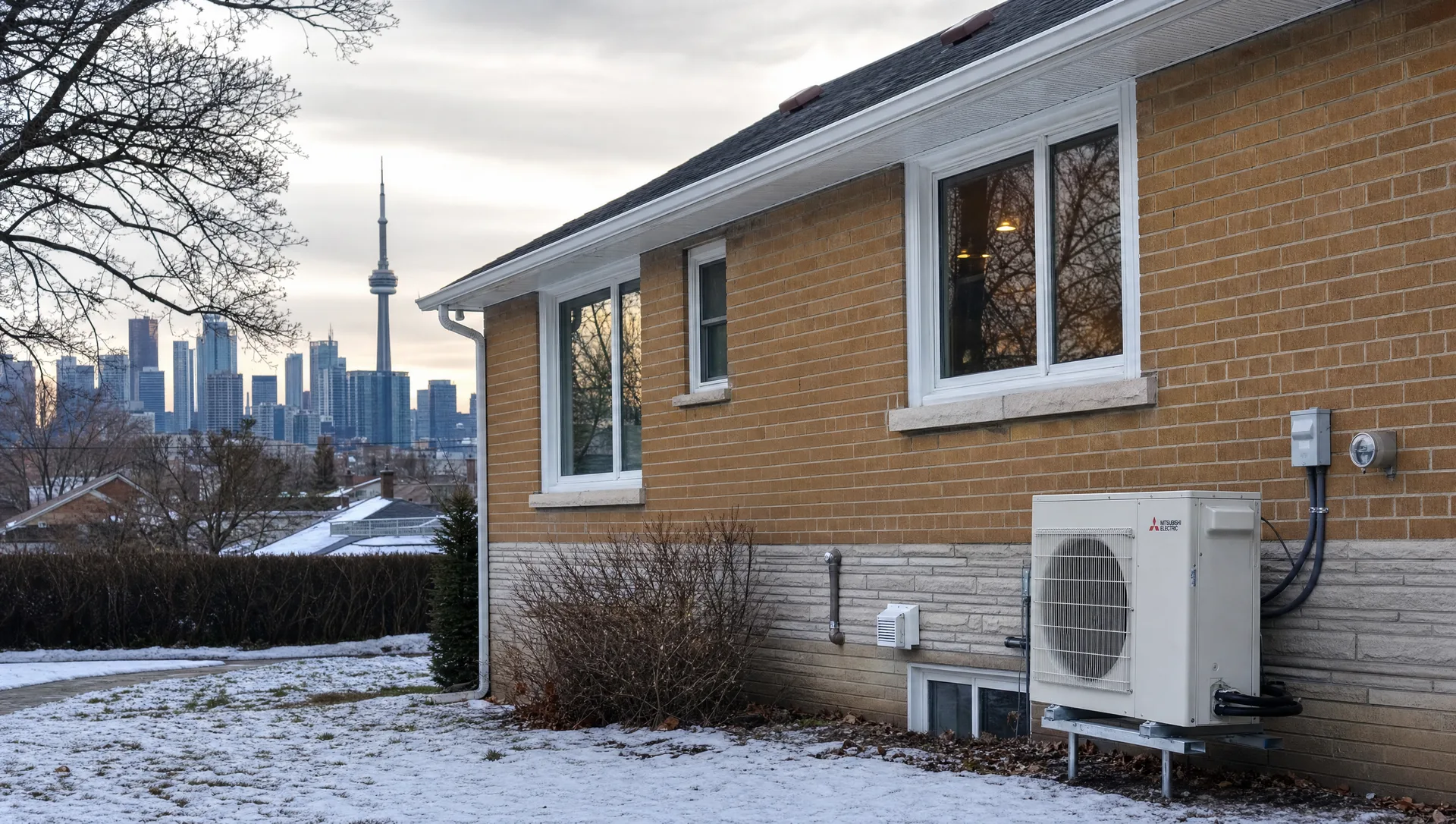
Toronto is one of the larger heat-pump installation markets in Ontario, with multiple licensed contractors covering the metro and the surrounding communities — enough competition that comparing three quotes is realistic.
Toronto's housing stock and climate context
Toronto's residential stock is predominantly 1900s-1970s with a substantial post-2010 condo and infill layer, which shapes both heat-loss characteristics and retrofit complexity. Lake Ontario moderates winter lows by 2-3°C compared to inland Ontario, while summer humidity from the lake pushes cooling loads higher than the design temperature suggests.
The neighbourhoods where this comes up most often include The Beaches, Leslieville, Riverdale, High Park, and North York. Housing vintage varies enough across them to change the equipment answer, which is why a load calculation beats a rule of thumb here.
The typical install scenario in Toronto
Older Victorian and Edwardian semis converting from gas furnaces to dual-fuel CCHPs, plus mid-century North York and Scarborough bungalows replacing aging AC + furnace combos with single units.
What gets installed in Toronto
- Ducted central heat pump — for homes with existing forced-air ductwork
- Ductless mini-split (single or multi-zone) — for homes without ducts or zone-specific needs
- Multi-zone ductless — for whole-home coverage in ductless configurations
- Oil-to-heat-pump conversion — if Toronto is one of Ontario's oil-heating markets
- Geothermal — for long-term Toronto owners willing to invest upfront for lowest operating cost
What to ask your installer in Toronto
- Manual J load calculation using Toronto's 99% winter design temperature, not a square-footage rule of thumb. More on this →
- AHRI matched-system certificate for the proposed indoor + outdoor combination — the document rebate programs ask for.
- Itemized rebate calculation showing federal + provincial + utility stack specific to your address.
- Outdoor unit placement appropriate for Toronto's conditions — elevated brackets, salt-air corrosion coatings, snow-clearance considerations where applicable.
Find a qualified installer
This site is a guide. It does not sell or install heat pumps. The programs and directories below are where to find registered contractors and the rebate rules that apply in each province.
- National Heat Pump Rebate (Government of Canada)
The new federal rebate announced in October 2026: up to $10,000 below the median income and $2,000 for others, opening in early 2027. The official page has a sign-up for launch updates.
- Canada Greener Homes Affordability Program (NRCan)
No-cost heat pump and insulation retrofits for low- and median-income homeowners and tenants, applied for through the provincial partner. The federal Greener Homes Loan and Oil to Heat Pump Affordability program are closed.
- HRAI contractor directory
The Heating, Refrigeration and Air Conditioning Institute of Canada lists member HVAC contractors by region.
- Home Renovation Savings — Ontario
Ontario's rebate for cold-climate and ground-source heat pumps, paid per ton, and its qualified-product rules.
- Home Renovation Rebate — British Columbia
The BC Hydro and CleanBC rebate for heat pumps that replace electric heat, and the program rules that go with it.
- Efficiency Manitoba
Manitoba rebates for ducted and ductless cold-climate heat pumps.
- Efficiency Nova Scotia
Nova Scotia rebate programs and the approved-installer requirements that go with them.
Common questions
How much does heat pump installation cost in Toronto?
Toronto pricing follows Ontario's provincial range: $12,000–$19,000 for a ducted air-source heat pump and $4,000–$8,500 for a single-zone ductless system. The Ontario row of the cost guide shows how those figures are built.
Are there licensed heat pump installers in Toronto?
Yes. The practical question is not whether they exist but how to verify one: check the provincial licensing registry, and ask for the AHRI certificate on the specific matched system being quoted. Provincial trade-licensing registries and the HRAI directory both cover Toronto.
Which rebates can I claim as a Toronto homeowner?
Programs that can apply in Ontario: Home Renovation Savings — cold-climate air-source heat pump ($1,250 per ton, up to $7,500), Home Renovation Savings — cold-climate air-source heat pump (gas-heated home) ($500 per ton, up to $2,000), Home Renovation Savings — ground-source heat pump ($2,000 per ton, up to $12,000), Home Renovation Savings — ground-source heat pump (gas-heated home) (up to $3,000). Separately, the federal National Heat Pump Rebate will add up to $10,000 for households below the median income, or $2,000 for others. It opens in early 2027 and covers eligible installs from November 1, 2026. The provincial rebate stacking guide walks through worked examples.
How long does installation take in Toronto?
Same as the provincial average: 1-2 days for a ducted retrofit, 1 day for ductless single-zone, 2-3 days for ductless multi-zone. Oil-to-heat-pump conversions take 2-3 days including tank decommissioning. Equipment delivery delays in Toronto are minimal — most installers carry common cold-climate models in stock. The 9-step installation process guide sets out the complete timeline from first quote to commissioning.